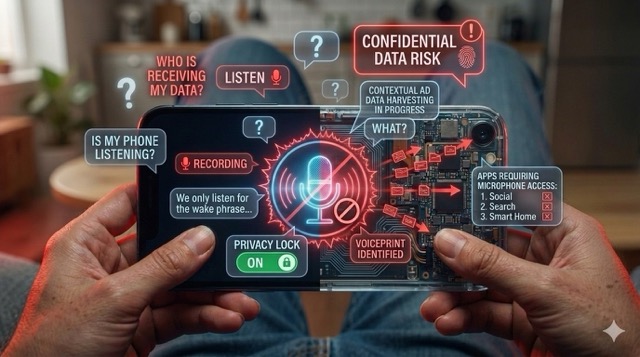
You’re talking to a friend about wanting to buy new running shoes. You never Googled it. You never typed it. And yet — the next time you open Instagram, there they are. Shoe ads. Everywhere. So the question everyone asks: is my phone secretly listening to my conversations?
The short answer is: not in the way you think. But the full answer is more interesting — and a little unsettling in a different way.
🎙️ What Actually Happens with “Hey Siri” and “OK Google”
Let’s start with the voice assistants, because this is where the confusion begins.
Your phone does have its microphone on all the time when you have voice assistants enabled. But — and this is the crucial part — it is not sending everything you say to Apple or Google’s servers.
Here’s what’s really happening under the hood.
Your phone has a tiny, dedicated chip called a wake word processor (Apple calls theirs the “Always-On Processor”). This chip does one job and one job only: it listens for a specific sound pattern — “Hey Siri” or “OK Google” — using an extremely simple, lightweight model that runs entirely on the chip itself, using almost no battery.
Think of it like a sleeping guard dog. The dog’s ears are always open, but its brain is mostly off. It only wakes up and starts paying attention when it hears a specific knock at the door. Until that knock, nothing it hears gets recorded, stored, or sent anywhere.
The moment it detects “Hey Siri,” the main processor wakes up, the full Siri system activates, and now your voice is processed — often partly on the device, partly on Apple’s servers. But everything before that trigger word? It never leaves your phone.
🧠 Why This Design Makes Sense
You might wonder — why not just process everything on the device and skip the cloud entirely? The answer is power and complexity.
A full AI assistant capable of understanding natural language, answering questions, and connecting to services requires a lot of computing power. Running that constantly on a battery-powered phone would drain it in hours. The wake word chip is a clever engineering solution — it’s specifically designed to be stupidly simple and use almost no power, so it can run 24/7 without killing your battery.
Apple’s Siri, Google Assistant, and Amazon’s Alexa on Echo devices all use this same two-stage approach:
| Stage | Where it runs | What it does |
|---|---|---|
| Wake word detection | On-device chip | Just listens for trigger phrase — no data sent anywhere |
| Full assistant | Device + cloud | Processes your actual request after wake word is heard |
📱 So Why Did I See That Shoe Ad?
This is the part that genuinely surprises people when they learn the truth: your phone doesn’t need to listen to your conversations to show you eerily relevant ads. It already knows more about you than you realise.
Here’s what your phone and apps actually track:
- Your location — If your phone’s GPS shows you walked into a Nike store for 20 minutes, that’s logged.
- Your browsing history — Even if you don’t search for shoes, if your friend does and you’re on the same Wi-Fi network, ad networks make inferences.
- What you type — Keyboards on Android in particular have broad permissions. Anything you type in a chat app could theoretically be logged by a third-party keyboard app.
- Your contacts’ behaviour — Facebook and others build “shadow profiles.” If your friends are all searching for running shoes, the algorithm assumes you might be interested too.
- App permissions — Many apps request microphone access for legitimate reasons (voice notes, video calls) and technically have access even when you’re not actively using them.
- Purchase history — Your bank card, loyalty apps, and shopping apps all build a detailed picture of your buying habits.
- Time and patterns — You always search for restaurants on Friday evenings. You browsed fitness gear last month. Algorithms are very good at predicting what you want before you consciously want it.
The combination of all this data is so powerful that targeted advertising can feel like mind-reading — even when no one is listening to a word you say.
🔬 Has Anyone Actually Proved Phones Listen?
Researchers and journalists have tested this repeatedly. The results are consistent:
- Multiple cybersecurity researchers have monitored network traffic from phones while having “trigger conversations” nearby — no audio data was uploaded.
- In 2019, a Vice investigation found that some apps were recording screens rather than audio, which felt just as invasive.
- Apple, Google, and Meta have all been asked about this under oath in US Congressional hearings. None of the technical evidence has supported the constant-listening theory.
What researchers have found is that some apps misuse microphone permissions in unexpected ways — mostly to detect what’s on TV near you (for ad targeting), not to eavesdrop on conversations. This is different but still concerning.
⚠️ The Real Privacy Risk
The honest truth is: the thing to worry about is not your phone listening. It’s your phone watching.
The data your apps collect about your behaviour, location, contacts, and habits is far more comprehensive — and far more valuable to advertisers — than any conversation. You don’t need to say “I want shoes.” Your phone already knows you walked past a shoe shop, that your fitness tracker shows you started running, and that you’ve been searching workout routines. The conclusion writes itself.
🛡️ What You Can Actually Do
If privacy matters to you, here are the changes that actually make a difference:
- Review app permissions — Go to Settings → Privacy and check which apps have microphone access. Revoke it for any app that doesn’t genuinely need it.
- Disable voice assistants when not needed — If you rarely use Siri or Google Assistant, turn off “Hey Siri” / “Hey Google” in settings.
- Limit location tracking — Set location access to “While Using” rather than “Always” for most apps.
- Use a privacy-focused browser — Safari with privacy settings enabled, or Firefox with uBlock Origin, significantly reduces ad tracking.
- Be mindful of smart speakers — Amazon Echo and Google Nest devices do sit in your home with always-on microphones. The same wake word logic applies, but accidental activations do happen — and those clips can be reviewed by employees in some cases.
🔮 The Bottom Line
Your phone is not secretly recording your dinner conversations and beaming them to Mark Zuckerberg. The “always listening” conspiracy, while understandable, doesn’t hold up technically.
What is happening is that the data ecosystem around your phone is so detailed, so interconnected, and so good at predicting human behaviour that it feels like someone must be listening. The reality is arguably more impressive — and more worth thinking carefully about.
The wake word chip is clever, privacy-respecting engineering. The ad targeting ecosystem that surrounds it is something else entirely. That’s where your attention — and your privacy settings — deserve to go.